The release of Claude Code 2.1 marks a fundamental shift in how we think about AI agent development. What appears on the surface as three incremental features: skill hot-reload, lifecycle hooks, and forked sub-agents; actually represents something far more profound. This transforms Claude Code from a sophisticated terminal code assistant into a full-fledged agent operating system.
This isn’t hyperbole. With 2.1, developers gain the ability to build live, governed, multi-agent systems using nothing more than Markdown files, YAML frontmatter, and shell scripts. No proprietary SDKs. No complex plugin architectures. Just a clean, composable runtime that treats agents as first-class infrastructure components.
The real breakthrough isn’t any single feature. It’s how they combine. Skill-scoped hooks enable portable governance. Sub-agent isolation creates policy islands. Hook emission becomes an inter-agent event bus. Together, these primitives unlock architectural patterns that were previously impossible: supervised agent swarms, dynamic task delegation, and real-time multi-agent coordination.
This article unpacks what actually changed in Claude Code 2.1, why it matters, and what it enables. If you’re building agent systems, this is the platform shift you’ve been waiting for.
Claude Code 2.1: The Governance and Coordination Layer for Agent Systems
Section titled “Claude Code 2.1: The Governance and Coordination Layer for Agent Systems”The new release, Claude Code 2.1 is often described in terms of three features:
- Skill hot-reload
- Lifecycle hooks
- Forked sub-agents
That framing is directionally correct; but it undersells what actually changed.
Hooks already existed before 2.1. What 2.1 introduces is new scoping dimensions for hooks, at the skill and sub-agent level, plus a live development loop and a first-class sub-agent execution model.
Together, these changes quietly transform Claude Code from:
“an AI assistant in your terminal”
into:
a governed, observable, multi-agent runtime.
Not just a tool.
Not just an IDE helper.
But an actual agent operating system.
1. Skill Hot-Reload: Live Agent Development
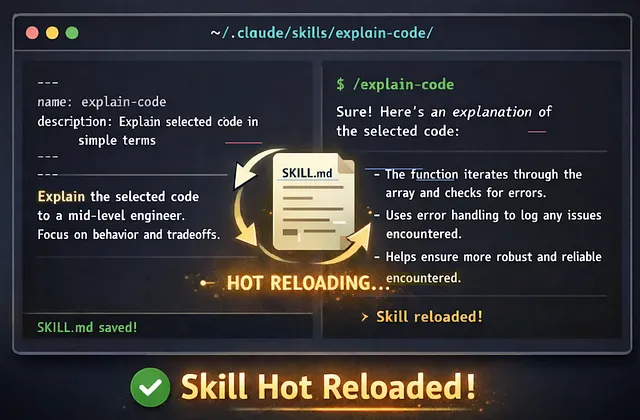
Section titled “1. Skill Hot-Reload: Live Agent Development”Claude Code 2.1 introduces automatic skill hot-reloading.
Any skill under:
~/.claude/skills(global).claude/skills(project)
is watched for changes.
Saving the file immediately updates the skill in your running session.
The development loop becomes:
Edit SKILL.md → Save → Run /skill-name → New behaviorNo restart.
No reinstall.
No session reset.
Every skill is defined by a SKILL.md file with YAML frontmatter and a Markdown body:
---name: explain-codedescription: Explain selected code in simple terms---Explain the selected code to a mid-level engineer. Focus on behavior and tradeoffs.This turns skills into live behavioral modules, not static configuration.
Skills now feel like hot, reloadable code, not static prompts.
2. Hooks Before 2.1: Centralized and Coarse
Section titled “2. Hooks Before 2.1: Centralized and Coarse”Hooks existed before 2.1, but only at two scopes:
- Global:
~/.claude/settings.json - Project:
.claude/settings.json
You could say:
“Whenever any tool runs, log it.”
But you could not say:
“When this specific skill runs, enforce safety checks.”
Hooks were:
- Centralized
- Coarse-grained
- Runtime-level only
They governed everything equally, which does not scale for complex systems.
3. What 2.1 Actually Introduced: Behavioral Scoping
Section titled “3. What 2.1 Actually Introduced: Behavioral Scoping”Claude Code 2.1 adds two new hook scopes:
Scope New in 2.1 Global ❌ existed Project ❌ existed Skill ✅ new Sub-agent ✅ new
Hooks now form a real hierarchy:
Global hooks ↓Project hooks ↓Skill hooks ↓Sub-agent hooksThis is the real platform shift.
Hooks become composable and layered, not just global switches.
4. Canonical Hook Configuration (JSON)
Section titled “4. Canonical Hook Configuration (JSON)”Hooks are command-based and configured in JSON:
{ "hooks": { "PostToolUse": [ { "matcher": "Write", "hooks": [ { "type": "command", "command": "say 'Task complete'" } ] } ] }}Key concepts:
- Event:
PreToolUse,PostToolUse,Stop, etc. - Matcher: string pattern for tools or skills.
- Command hooks: external scripts invoked by Claude.
Claude sends structured JSON on stdin.
Your script controls behavior via exit codes and stdout.
There is also an interactive command:
/hooksWhich lets you:
- Create hooks interactively
- Edit
settings.json - Reload hooks live
In managed environments, allowManagedHooksOnly can restrict hooks to centrally approved ones; an important enterprise governance feature.
5. Sub-Agent Hooks: Policy Islands — Agentic Policy Enforcement and Content Injection
Section titled “5. Sub-Agent Hooks: Policy Islands — Agentic Policy Enforcement and Content Injection”Sub-agent frontmatter supports hooks directly:
---name: code-reviewerdescription: Review code changes with linting
hooks:  PreToolUse:    - matcher: "Bash"      hooks:        - type: command          command: "./scripts/validate-command.sh"  PostToolUse:    - matcher: "Edit|Write"      hooks:        - type: command          command: "./scripts/run-linter.sh"---
These hooks:
- Only run while that sub-agent is active
- Support all lifecycle events
- Apply only to that agent
This makes each sub-agent a policy island.
You can build agents that are:
- Read-only
- Write-restricted
- Network-blocked
- Tool-whitelisted
Not by prompt.
Not by instruction.
By runtime enforcement.
This is real sandboxing.
6. Hooks in Agent Skill Frontmatter: Governed Agent Skills
Section titled “6. Hooks in Agent Skill Frontmatter: Governed Agent Skills”Claude Code 2.1 extends the same frontmatter pattern to skills.
The skills documentation now lists hooks as a valid frontmatter field, and 2.1 announcements explicitly state:
Hooks can be added directly to agents and skills frontmatter*.*
Which means this is now supported:
---name: guarded-shelldescription: Shell with safety checks
hooks:  PreToolUse:    - matcher: "Bash"      hooks:        - type: command          command: "~/.claude/hooks/validate-shell.sh"---
This changes what a skill is.
A skill is no longer just instructions.
It becomes:
Instructions + automation + policy
You can distribute a skill and it carries its operational semantics with it.
Skills become portable, governed behavioral units.
7. Forked Agent Skills: context: fork
Section titled “7. Forked Agent Skills: context: fork”Understanding context: fork as Runtime Sub-Agent Spawning
Section titled “Understanding context: fork as Runtime Sub-Agent Spawning”The context: fork field fundamentally changes what happens when you invoke a skill.
Without context: fork:
- The skill injects instructions into the current conversation
- All context is shared
- The skill executes in the main agent’s thread
With context: fork:
- The skill spawns a new sub-agent process
- That sub-agent runs in isolated context
- The sub-agent uses the
agent:field as its system prompt - The sub-agent can have its own hooks
- When complete, only the final result is returned to the parent
This means:
A skill with
***context: fork***is not an instruction set; it is a sub-agent constructor.
At runtime, invoking /deep-review does not just run a prompt.
It:
- Spawns a new agent process
- Initializes it with the
agent: Exploresystem prompt - Applies any skill-level hooks defined in frontmatter
- Runs the task in isolation
- Returns only the summary
The parent agent never sees the internal reasoning, tool use, or intermediate steps.
This is true background execution.
The skill becomes a callable sub-agent, not a prompt fragment.
And because sub-agents can emit hooks, the parent can observe progress without polluting context.
This is the key architectural insight:
*context: fork*turns skills into invokable agent processes with their own lifecycle, governance, and observability.
It is not syntax sugar.
It is a process model.
Claude Code 2.1 introduces a new frontmatter field:
context: forkWhen set on a skill:
---name: deep-reviewcontext: forkagent: Explore---Invoking /deep-review:
- Spawns a sub-agent
- Uses
agent: Exploreas system prompt - Runs in isolated context
- Returns only a summarized result
No prompt pollution.
No state leakage.
True parallel agent execution.
There is no **/fork** command — this is purely frontmatter-driven.
8. The Inverse Pattern: Sub-Agents That Load Skills
Section titled “8. The Inverse Pattern: Sub-Agents That Load Skills”The dual composition model is:
---name: api-developerskills: - api-conventions - error-handling-patterns---Here:
- The sub-agent defines the system prompt
- Skills act as injected domain knowledge
Two symmetric patterns:
Pattern Who owns system prompt Role of skills context: fork on skill Agent type Skill is the task skills: on sub-agent Sub-agent Skills are references
Sub-agents must be reloaded via:
/agentsThey are not hot-reloaded like skills.
9. Hooks as an Agent Event Bus
Section titled “9. Hooks as an Agent Event Bus”This is the most important architectural insight.
Because hooks can:
- Emit logs
- Emit JSON
- Call external systems
- Write state
Sub-agents can now emit structured status signals.
Which means:
Agents can observe other agents.
Hooks become:
- Telemetry
- Monitoring
- Coordination signals
Not just automation.
They form an inter-agent event bus of sorts.
10. The Queen Agent / Agent Swarm Pattern
Section titled “10. The Queen Agent / Agent Swarm Pattern”With forked sub-agents and hook emission, you can build:
A queen agent supervising a swarm.
Architecture:
Queen Agent | +-- Spawns sub-agents | +-- Sub-agents emit: - progress via hooks - status via hooks - errors via hooks | +-- Queen observes hook stream | +-- Queen decides: - retry - reassign - terminate - escalateHooks become:
The nervous system of the agent swarm.
This is not a named product feature; it is an emergent architecture enabled by the primitives in 2.1.
And it is the missing piece in almost every agent framework.
11. Is Claude Code Is Now an Agent OS
Section titled “11. Is Claude Code Is Now an Agent OS”Putting it all together:
Capability Meaning Skill hot-reload Live agent development Skill-scoped hooks Portable governance Sub-agent hooks Policy islands context: fork True parallel agents Hook emission Inter-agent signaling External commands Real-world integration
Claude Code is no longer:
“An AI coding assistant in your terminal.”
It is now?:
An agent operating system.
With:
- A runtime
- A module system
- A governance layer
- A process model
- An event bus
All defined with:
- Markdown
- YAML
- JSON
- Shell scripts
No SDK. (Of course you can use Claude Agent SDK)
No plugin runtime.
No proprietary extensions.
Just:
Agents as infrastructure.
And Claude Code 2.1 is the release where that finally becomes true.
Accuracy & Scope Notes
Section titled “Accuracy & Scope Notes”All platform features described here are based on the documented behavior of Claude Code 2.1 and public release coverage:
- Hooks existed before 2.1 but were limited to global and project scopes.
- Claude Code 2.1 introduces skill- and sub-agent-scoped hooks via frontmatter.
context: fork, skill hot-reload, and sub-agent isolation are real, documented features.- Examples such as skill-level validation hooks and sub-agent sandboxing reflect real usage patterns.
Some architectural patterns discussed: such as “queen agents”, agent swarms, and hooks as an inter-agent event bus; are interpretive design patterns, not official Anthropic terminology.
They are enabled by the platform, not prescribed by it.
In other words:
The features are factual.
The swarm architecture is emergent.
About the Author
Section titled “About the Author”Rick Hightower is a technology executive and data engineer who led ML/AI development at a Fortune 100 financial services company. He created skilz, the universal agent skill installer, supporting 30+ coding agents including Claude Code, Gemini, Copilot, and Cursor, and co-founded the world’s largest agentic skill marketplace. Connect with Rick Hightower on LinkedIn or Medium.
The Claude Code community has developed powerful extensions that enhance its capabilities. Here are some valuable resources from Spillwave Solutions (Spillwave Solutions Home Page):
Integration Skills
Section titled “Integration Skills”- Notion Uploader/Downloader Agent Skill: Seamlessly upload and download Markdown content and images to Notion for documentation workflows
- Confluence Agent Skill: Upload and download Markdown content and images to Confluence for enterprise documentation
- JIRA Integration Agent Skill: Create and read JIRA tickets, including handling special required fields
From building systems at Apple to pioneering AI at Capital One and the NFL: I’ve spent 20 years making enterprise software truly intelligent. I architect AI.
More from Rick Hightower
Section titled “More from Rick Hightower”Recommended from Medium
Section titled “Recommended from Medium”[
See more recommendations