Smart research habits for curious adults Jan 28, 2026
[
[Printable PDF available at the end.]
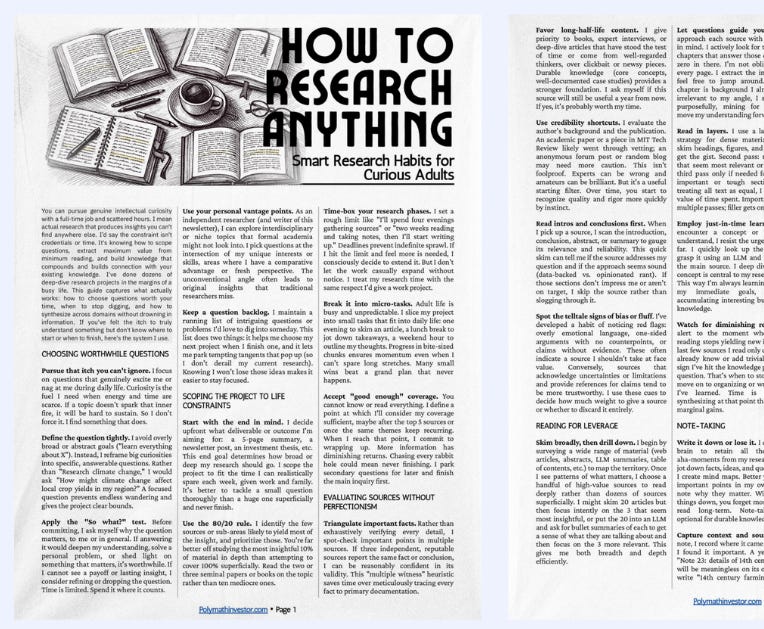
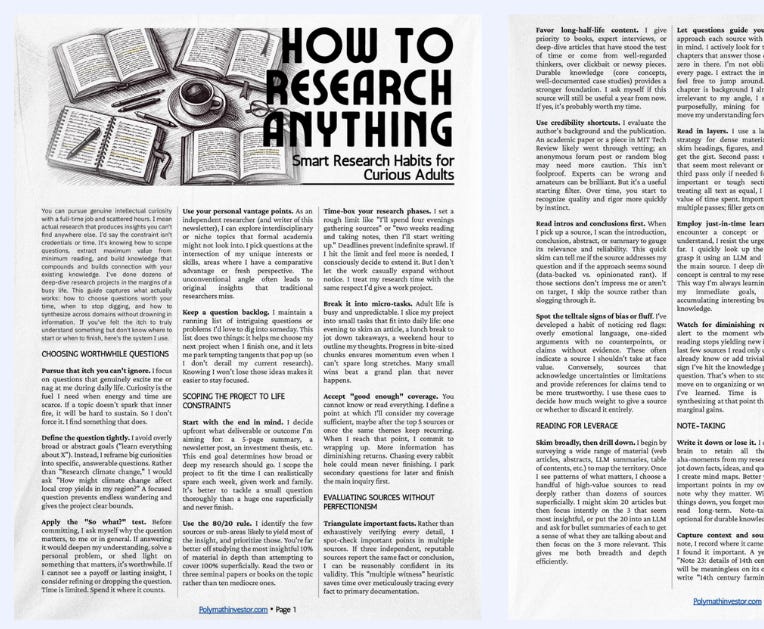
You can pursue genuine intellectual curiosity with a full-time job and scattered hours. I mean actual research that produces insights you can’t find anywhere else.
I’d say the constraint isn’t credentials or time. It’s knowing how to scope questions, extract maximum value from minimum reading, and build knowledge that compounds and builds connection with your existing knowledge.
I’ve done dozens of deep-dive research projects in the margins of a busy life. This guide captures what actually works: how to choose questions worth your time, when to stop digging, and how to synthesize across domains without drowning in information. I’ve tried to keep the best practices general: they apply whether you’re researching supply chains, behavioral science, or local history, not just investment themes.
If you’ve felt the itch to truly understand something but don’t know where to start or when to finish, here’s the system I use.
[


CHOOSING WORTHWHILE QUESTIONS
Section titled “CHOOSING WORTHWHILE QUESTIONS”Pursue that itch you can’t ignore. I focus on questions that genuinely excite me or nag at me during daily life. Curiosity is the fuel I need when energy and time are scarce. If a topic doesn’t spark that inner fire, it will be hard to sustain. So I don’t force it. I find something that does.
Define the question tightly. I avoid overly broad or abstract goals (”learn everything about X”). Instead, I reframe big curiosities into specific, answerable questions. Rather than “Research climate change,” I would ask “How might climate change affect local crop yields in my region?” A focused question prevents endless wandering and gives the project clear bounds.
Apply the “So what?” test. Before committing, I ask myself why the question matters, to me or in general. If answering it would deepen my understanding, solve a personal problem, or shed light on something that matters, it’s worthwhile. If I cannot see a payoff or lasting insight, I consider refining or dropping the question. Time is limited. Spend it where it counts.
Use your personal vantage points. As an independent researcher (and writer of this newsletter), I can explore interdisciplinary or niche topics that formal academia might not look into. I pick questions at the intersection of my unique interests or skills, areas where I have a comparative advantage or fresh perspective. The unconventional angle often leads to original insights that traditional researchers miss.
Keep a question backlog. I maintain a running list of intriguing questions or problems I’d love to dig into someday. This list does two things: it helps me choose my next project when I finish one, and it lets me park tempting tangents that pop up (so I don’t derail my current research). Knowing I won’t lose those ideas makes it easier to stay focused.
SCOPING THE PROJECT TO LIFE CONSTRAINTS
Section titled “SCOPING THE PROJECT TO LIFE CONSTRAINTS”Start with the end in mind. I decide upfront what deliverable or outcome I’m aiming for: a 5-page summary, a newsletter post, an investment thesis, etc. This end goal determines how broad or deep my research should go. I scope the project to fit the time I can realistically spare each week, given work and family. It’s better to tackle a small question thoroughly than a huge one superficially and never finish.
Use the 80/20 rule. I identify the few sources or sub-areas likely to yield most of the insight, and prioritize those. You’re far better off studying the most insightful 10% of material in depth than attempting to cover 100% superficially. Read the two or three seminal papers or books on the topic rather than ten mediocre ones.
Time-box your research phases. I set a rough limit like “I’ll spend four evenings gathering sources” or “two weeks reading and taking notes, then I’ll start writing up.” Deadlines prevent indefinite sprawl. If I hit the limit and feel more is needed, I consciously decide to extend it. But I don’t let the work casually expand without notice. I treat my research time with the same respect I’d give a work project.
Break it into micro-tasks. Adult life is busy and unpredictable. I slice my project into small tasks that fit into daily life: one evening to skim an article, a lunch break to jot down takeaways, a weekend hour to outline my thoughts. Progress in bite-sized chunks ensures momentum even when I can’t spare long stretches. Many small wins beat a grand plan that never happens.
Accept “good enough” coverage. You cannot know or read everything. I define a point at which I’ll consider my coverage sufficient, maybe after the top 5 sources or once the same themes keep recurring. When I reach that point, I commit to wrapping up. More information has diminishing returns. Chasing every rabbit hole could mean never finishing. I park secondary questions for later and finish the main inquiry first.
EVALUATING SOURCES WITHOUT PERFECTIONISM
Section titled “EVALUATING SOURCES WITHOUT PERFECTIONISM”Triangulate important facts. Rather than exhaustively verifying every detail, I spot-check important points in multiple sources. If three independent, reputable sources report the same fact or conclusion, I can be reasonably confident in its validity. This “multiple witness” heuristic saves time over meticulously tracing every fact to primary documentation.
Favor long-half-life content. I give priority to books, expert interviews, or deep-dive articles that have stood the test of time or come from well-regarded thinkers, over clickbait or newsy pieces. Durable knowledge (core concepts, well-documented case studies) provides a stronger foundation. I ask myself if this source will still be useful a year from now. If yes, it’s probably worth my time.
Use credibility shortcuts. I evaluate the author’s background and the publication. An academic paper or a piece in MIT Tech Review likely went through vetting; an anonymous forum post or random blog may need more caution. This isn’t foolproof. Experts can be wrong and amateurs can be brilliant. But it’s a useful starting filter. Over time, you start to recognize quality and rigor more quickly by instinct.
Read intros and conclusions first. When I pick up a source, I scan the introduction, conclusion, abstract, or summary to gauge its relevance and reliability. This quick skim can tell me if the source addresses my question and if the approach seems sound (data-backed vs. opinionated rant). If those sections don’t impress me or aren’t on target, I skip the source rather than slogging through it.
Spot the telltale signs of bias or fluff. I’ve developed a habit of noticing red flags: overly emotional language, one-sided arguments with no counterpoints, or claims without evidence. These often indicate a source I shouldn’t take at face value. Conversely, sources that acknowledge uncertainties or limitations and provide references for claims tend to be more trustworthy. I use these cues to decide how much weight to give a source or whether to discard it entirely.
READING FOR LEVERAGE
Section titled “READING FOR LEVERAGE”Skim broadly, then drill down. I begin by surveying a wide range of material (web articles, abstracts, LLM summaries, table of contents, etc.) to map the territory. Once I see patterns of what matters, I choose a handful of high-value sources to read deeply rather than dozens of sources superficially. I might skim 20 articles but then focus intently on the 3 that seem most insightful, or put the 20 into an LLM and ask for bullet summaries of each to get a sense of what they are talking about and then focus on the 3 more relevant. This gives me both breadth and depth efficiently.
Let questions guide your reading. I approach each source with my questions in mind. I actively look for the sections or chapters that answer those questions, and zero in there. I’m not obligated to read every page. I extract the info I need and feel free to jump around. If an entire chapter is background I already know or irrelevant to my angle, I skip it. I read purposefully, mining for insights that move my understanding forward.
Read in layers. I use a layered reading strategy for dense material. First pass: skim headings, figures, and summaries to get the gist. Second pass: read the parts that seem most relevant or novel. Take a third pass only if needed for particularly important or tough sections. By not treating all text as equal, I maximize the value of time spent. Important details get multiple passes; filler gets one or none.
Employ just-in-time learning. When I encounter a concept or term I don’t understand, I resist the urge to detour too far. I quickly look up the minimum to grasp it using an LLM and then return to the main source. I deep dive only if that concept is central to my research question. This way I’m always learning in service of my immediate goals, rather than accumulating interesting but sidetracking knowledge.
Watch for diminishing returns. I stay alert to the moment when additional reading stops yielding new insights. If the last few sources I read only confirm what I already know or add trivial details, it’s a sign I’ve hit the knowledge plateau on this question. That’s when to stop reading and move on to organizing or writing up what I’ve learned. Time is better spent synthesizing at that point than hunting for marginal gains.
NOTE-TAKING
Section titled “NOTE-TAKING”Write it down or lose it. I don’t trust my brain to retain all the details or aha-moments from my research. It won’t. I jot down facts, ideas, and questions as I go. I create mind maps. Better yet, I rephrase important points in my own words and note why they matter. Without writing things down, you forget most of what you read long-term. Note-taking is not optional for durable knowledge.
Capture context and source. For each note, I record where it came from and why I found it important. A year from now, “Note 23: details of 14th century farming” will be meaningless on its own. Instead, I write “14th century farming techniques, could explain why wheat yields plateaued (Source: Smith 2019, ch. 2).” Giving context ensures I can pick up the thread later and understand the significance of the note in isolation.
Keep ideas modular. I don’t bury multiple insights in one mega-note. I write one idea or fact per note (whether I use a notebook, index cards, or digital notes). This makes it easy to reorganize, combine, and reference ideas without losing clarity. Each note should represent a single nugget of knowledge that can stand on its own. If I revisit the topic in five years, I can selectively pull out relevant nuggets instead of wading through dense, outdated summaries.
Link and cluster related notes. Over time, I accumulate lots of notes. I develop a simple system to connect them: tagging, cross-references, or an index. I tag notes that relate to “defence spending” or link a note about one historian’s view to another note with a different view. These connections help me see the bigger picture and synthesize information. My personal knowledge base becomes more than the sum of individual facts when I see how ideas relate (my own version of a Zettelkasten system).
Periodically review and prune. I schedule occasional reviews of my notes (perhaps monthly or at the end of a project, or when I hit 50 pages on my notebook). Refreshing my memory on past notes strengthens retention and often triggers new insights, especially as I accumulate knowledge in adjacent areas. I also prune or consolidate notes that are no longer useful: outdated links or duplicate facts. Regular maintenance keeps my archive useful, and the act of reviewing itself reinforces my learning.
SYNTHESIZING ACROSS DOMAINS
Section titled “SYNTHESIZING ACROSS DOMAINS”Find patterns and analogies. As I venture into different fields, I actively look for common themes or structures. I ask “What does this remind me of?” When I recognize a familiar pattern (say, the typical example of a feedback loop in ecology that resembles one in economics), I take note. Literally. Connecting dots across domains is the mark of deep understanding and can spark original ideas. The more patterns I catalog, the easier it becomes to integrate new knowledge with what I already know.
Translate concepts between contexts. I try expressing an idea from one domain in the language of another. If I learn about a biological “immune system,” I think of how a similar concept might exist in software security or in cultural norms. This mental translation forces me to truly understand the core principles. It also exposes which aspects of the concept are fundamental versus context-specific.
Use simple frameworks as bridges. You don’t need advanced formal theories to synthesize across fields. I lean on simple, durable frameworks like systems vs. components, supply and demand, evolution and selection, feedback cycles, etc. When approaching a new domain, I see if one of these basic models fits as a starting point. It gives me a foothold without having to learn the domain’s entire complexity up front. I can then refine the model as I learn specifics.
Embrace outsider advantages. Coming from outside a field, I might question assumptions insiders take for granted. I use that to my advantage: ask “dumb” questions and draw parallels that a specialist might overlook. Many breakthroughs happen by applying an idea from Field A to Field B. But I balance this. Not every outsider insight is a novel idea to experts. I check if my “new” idea has been tried or why it might not apply.
Synthesize in public or on paper. One of the best ways to solidify a cross-domain insight is to explain it. Write a blog post, make a forum comment, or just jot a one-pager for yourself that lays out how concept X from one domain illuminates problem Y in another. The act of articulation clarifies your thinking and reveals any weak points in the analogy. If you share it, feedback from others (even just a friend’s reaction) can further refine your understanding.
KNOWING WHEN RESEARCH IS “GOOD ENOUGH”
Section titled “KNOWING WHEN RESEARCH IS “GOOD ENOUGH””Define “done” at the start. As I mentioned in the Constraints… section: I set clear criteria for success before I get deep into the weeds. It could be as simple as “I’ll consider this research done when I can explain the main answer to my question in a 10-minute mini-lecture” or “when I’ve gathered enough info to make decision X confidently.” Having a definition of done guards against the infinite research spiral. Once I meet my criterion, I allow myself to stop digging.
Recognize the plateau of diminishing returns. I stay vigilant for the point where each additional source or hour yields negligible new insights. That’s the point of diminishing returns, and it’s a strong signal to wrap up. Experienced researchers learn to sense this threshold. Often it’s when you start encountering the same facts or arguments repeatedly. When I hit that plateau, I shift from gathering mode into synthesizing mode.
Use time or resource caps. If you have perfectionist tendencies, deliberately limit your research phase. “I’ll spend no more than 3 weeks or read no more than 8 sources on this question.” A hard cap forces you to prioritize and focus on the best sources. Often, it also spurs productive urgency. You know you have to finish, so you zero in on what matters most.
Fight the sunk-cost fallacy. Just because I’ve invested a lot of time in a line of inquiry doesn’t mean I must keep going if it’s not panning out. I’m willing to cut my losses on a dead-end. A simple heuristic: ask “If I haven’t found satisfying answers after X effort, how likely is it that more effort will change that?” If the answer is “not very likely,” it’s time to stop or pivot my approach. Independent researchers must be their own advisor and know when to say “enough.”
Conclude with a deliverable. I cement my “good enough” point by producing something: a summary, a presentation, a mind map of the findings, or even a discussion with a peer. This final output forces me to consolidate what I learned and formally marks the end of the project. It gives closure, a sense of achievement, and a reference I can return to later. It also prevents the feeling that I should still be researching. Once I’ve delivered the outcome, that’s it.
MAINTAINING MOMENTUM WITHOUT DEADLINES
Section titled “MAINTAINING MOMENTUM WITHOUT DEADLINES”Make it routine. I treat my hobby research like an appointment with myself. I set aside a regular slot (early mornings or Sunday nights) and stick to it, even if for just 30 minutes. Consistency builds a habit, and habits carry you through bouts of low motivation. Research momentum is about steady, habitual engagement.
Exploit bursts of energy. When I feel a surge of interest or find an unexpected free afternoon, I capitalize on it. Let inspiration find you when you are working! I dive deeper or tackle a challenging aspect while I’m energized. Think of these bursts as deposits in a momentum bank. Later, when I’m busy or less inspired, I ride on the progress I banked during high-energy periods.
Create accountability for one. I use lightweight external pressure to keep going. I tell a friend or spouse about my current research goal and promise to share what I find by a certain date. Knowing someone might ask “Hey, how’s that project?” can prod me to make progress. If social accountability isn’t your style, even setting a reminder in your calendar (”Report progress on project X”) can help you to stay on track.
Alternate hard and easy tasks. I maintain momentum by mixing the intellectually heavy tasks with lighter ones. After an evening of fighting with a tough concept or dense paper, I give myself a break next session by doing something easier but still useful: organizing my bibliography, searching for relevant videos, or revisiting a favorite source. This alternation prevents burnout while ensuring I’m always moving forward on some front.
Keep it enjoyable. I inject play and personal pleasure into the process. I use tools and formats I like. If you’re a visual thinker, draw diagrams of what you learn; if you love conversation, record yourself speaking your notes out loud or discuss with a like-minded friend. Set up your research environment how you like it: maybe it’s a corner with a cup of tea or a whiteboard and colored markers. The more you enjoy the act of researching, the less you’ll need to rely on sheer willpower to continue.
Reflect and reward. I take a moment periodically to acknowledge how far I’ve come. I flip through my notes or recall what I knew about the topic a month ago versus now. Seeing the progress can be motivating. I reward myself when I hit milestones: finish a big book? Treat yourself to a nice dinner or a day off. Positive reinforcement it’s how you train your brain that this hard work is worth it. Over the long run, this builds a virtuous cycle of motivation.
CRAFTING A PERSONAL RESEARCH PLAYBOOK
Section titled “CRAFTING A PERSONAL RESEARCH PLAYBOOK”Play the long game. I optimize my research for long-term wisdom as well. I favor knowledge that will stay relevant (core principles, historical cases, skills) over simple current news. Think of your mind as building a library. Over years, the compounding of stable knowledge and mental models will far outweigh any short-lived excitement from looking at those catchy headlines in social media apps.
Reflect on your process. I regularly step back and assess how I’m doing research, not just what I’m learning. I note what techniques kept me energized or what wasted time. Maybe I realize I get more from morning study than late nights, or that writing a quick outline before diving into sources saves me time. These meta-insights is how I keep pushing forward. They let me continuously refine my approach. My methodology is a work-in-progress that improves with each project.
Embrace mistakes and iteration. I treat my independent research like an experiment. I will have false starts, blind alleys, and conclusions that later prove incomplete or wrong. And that’s fine. Rather than seeing it as failure, I view it as iterating toward deeper understanding. Each project teaches me not just about the topic, but about the process of learning itself. My errors are my teachers.
Stay proactive and self-directed. In formal settings, advisors or bosses set goals and check your progress. As an independent researcher, I must generate that structure. I set targets, ask myself probing questions, and push for clarity. If something isn’t working (I have 116 draft posts in the Substack app!) I take initiative to change it or discard it (again, fight the sunk-cost fallacy). The less default structure you have, the more you must create your own. The upshot is complete intellectual freedom. I’m steering the ship, so I don’t hesitate to chart a new course when needed.
Build a knowledge portfolio. I think of each research project as an investment in my overall intellectual growth. I aim for a balance: some projects purely for passion, others to build useful skills or knowledge in areas I value. Over time, I accumulate a diverse portfolio of expertise and experiences. This diversity pays off in unexpected ways: ideas from one project will inform another, and I develop a personal universe of interconnected insights that no one else has in quite the same combination. This is the ultimate reward of a serious independent researcher. A mind richly furnished with understanding, earned by curiosity and craft over years.
Sometimes, having a certain kind of research infrastructure can be of great help to speed up the process.
The two systems that have given me the most leverage in this sense are: a curated network of experts who can compress weeks of reading into one conversation, and a repeatable pipeline for converting messy data into outputs.
Both take time to build. The sections that follow are specifically targeted to investment research, though the principles apply broadly to any domain where research needs to drive decisions.