The AI Agent Race is Over. The Winner is a Folder
Section titled “The AI Agent Race is Over. The Winner is a Folder”Or; Agent Skills for the masses.
The Expert’s Prison
Section titled “The Expert’s Prison”Dr. Elara Vance, head of clinical strategy, stares at her screen. It’s 8 PM. A single question blocks the launch of a billion-dollar drug trial: “Does our new recruitment protocol conflict with the FDA’s updated guidance on cardiovascular risk from 2023?”
The answer is buried in a 400-page regulatory PDF, cross-referenced against a dozen internal spreadsheets. To find it, she’d need to coordinate a data scientist who doesn’t understand pharmacology and a junior lawyer who doesn’t know the regulatory history. The knowledge is in the building, but it’s fractured, siloed, and inert.
Dr. Vance’s dilemma is not unique.
It is the quiet frustration of every knowledge worker trapped by their own expertise. A VP of Sales knows exactly which contract clauses are non-standard but cannot build a tool to flag them. A financial analyst understands the precise adjustments needed to forecast revenue, but their logic remains locked in a personal spreadsheet no one else can run.
This is the expert’s prison.

You possess the knowledge, honed over a decade of experience, but you lack the ability to turn that knowledge into a scalable, automated process. You must rely on generalist developers who do not speak your language, leading to endless meetings and tools that miss the mark. Your unique insight, the very thing that makes you valuable, remains a manual, unrepeatable art form.
For years, the promise of artificial intelligence was that it would solve this, yet the tools remained disconnected from the experts. But what if the barrier between knowing and building simply dissolved? What if an expert could translate their wisdom into a durable, digital asset, without needing a team of engineers to do it?
The Unlock: An Agent in a Folder
Section titled “The Unlock: An Agent in a Folder”The solution to the expert’s prison is not a monolithic, all-knowing AI. Sprawling infrastructure, no, it is something far simpler and more powerful: a folder.
This is the core idea behind a new paradigm called “Agent Skills,” championed by researchers at companies like Anthropic. A skill is a self-contained package of procedural knowledge. It’s a folder containing plain text instructions, simple scripts, and the specific data an expert uses to make decisions. The AI doesn’t need to have the knowledge pre-installed. It just needs to be able to read the folder.
Here’s a real example from Anthropic’s cookbook, a skill for analyzing financial statements:
analyzing-financial-statements/├── SKILL.md├── calculate_ratios.py└── interpret_ratios.pyThe magic is in the SKILL.md file. It starts with simple YAML metadata that tells Claude when to activate:
---name: analyzing-financial-statementsdescription: This skill calculates key financial ratios and metrics from financial statement data for investment analysis---The description field is critical. Claude reads it semantically to decide when to load the skill. When a user says “analyze this balance sheet,” Claude matches that request against all available skill descriptions and activates the relevant ones.
Below the metadata comes plain English instructions: what ratios to calculate (ROE, ROA, P/E, debt-to-equity), what input formats to accept (CSV, JSON, Excel), and how to interpret the results. The Python scripts handle the actual math. The skill combines human judgment with machine execution.
A second real example shows how brand consistency gets encoded. A marketing team’s applying-brand-guidelines skill contains:
---name: applying-brand-guidelinesdescription: Applies consistent corporate branding and styling to all generated documents including colors, fonts, layouts, and messaging---The skill then specifies exact design tokens:
- primary blue (#0066CC),
- header font (Segoe UI, 32pt bold),
- PowerPoint margins (0.5 inches),
- Excel header styling (blue background, white text).
Every document Claude creates now follows the brand book, without anyone having to remind it.
Now imagine Dr. Vance, our frustrated clinical strategist, builds her own skill:
protocol_risk_analyzer/├── SKILL.md├── analyze_protocol.py└── data/ ├── fda_guidance_cardiovascular.txt └── known_contraindications.csvHer SKILL.md might read:
---name: protocol-risk-analyzerdescription: Analyzes clinical trial protocols against FDA guidance and known contraindications to identify patient recruitment risks---# InstructionsYou are an expert clinical trial strategist. When given a protocol:1. Parse the Inclusion Criteria, Exclusion Criteria, and Procedures2. Run analyze_protocol.py against the contraindications database3. Cross-reference findings with FDA guidance in data/4. Flag any "High" or "Critical" risks immediately5. Output a three-part report: Risk Score, Critical Factors, RecommendationsShe has successfully packaged her expertise.
The FDA documents and contraindication database in data/ represent years of accumulated knowledge. The script automates the tedious cross-referencing. The instructions encode her decision-making process. A decade of experience, now executable.
This approach makes a radical architectural claim: the model is the agent. It doesn’t need complex scaffolding to operate. The agent runtime can be as thin as the file system itself. The AI uses its powerful reasoning to read the skill’s contents and decide what to do, just like a human reading a standard operating procedure.
This minimalism stands in stark contrast to many early agent frameworks, which often require complex chains of code to connect models to tools.
The “Skills” philosophy argues this is unnecessary. The model is smart enough to orchestrate its own workflow, as long as you give it the right documents to read. Code and text are the universal interface.
The profound, and almost disarmingly simple, realization is that yes, it really is just a folder.

The New Power Dynamic
Section titled “The New Power Dynamic”This shift in tooling creates a fundamental change in organizational power. For the first time, the people who know the business can build the tools for the business. The expert is no longer dependent on a developer who doesn’t understand the nuances of their domain.
The advantage is not that skills are “easy” to build, but that domain experts are uniquely qualified to build them correctly. A developer can write a script to calculate a P/E ratio.
A Managing Director in finance, however, builds a skill that calculates the Adjusted Forward P/E using non-GAAP EBITDA, excluding goodwill amortization from the Q2 acquisition, for comparison against a specific peer set. The code is simple. The embedded knowledge is the entire value.
This trend also provides a powerful antidote to one of the biggest risks in enterprise AI, often called “Shadow AI.” The real shadow AI is not a rogue agent. It’s an analyst copy-pasting an answer from a public chatbot into a critical financial model. That action is invisible, untraceable, and based on a prompt no one can audit.
Skills pull this activity out of the shadows and make it visible. A skill is a version-controlled asset in a repository. It is auditable, meaning you can see the exact instructions and code the AI used. It is testable, ensuring the logic is sound. And it is attributable, with a clear owner. For the first time, AI usage becomes a manageable, governable process.
This transition from invisible prompts to visible assets creates a new and unavoidable tension. When anyone can create enterprise-grade AI tools, who is in control? The battle over AI is not just a technical challenge. It is a political one. It’s a fight for who owns and operates the company’s evolving, collective intelligence.
The Compounding Flywheel (and its Discontents)
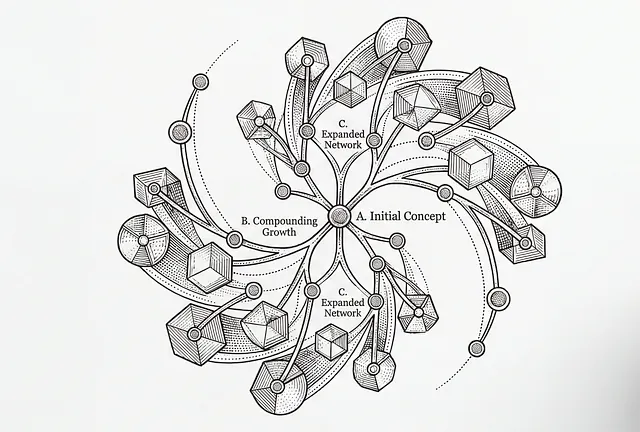
Section titled “The Compounding Flywheel (and its Discontents)”Anthropic’s vision is that an AI on day 30 should be far more capable than it was on day one. This isn’t because the underlying model changed, but because the library of skills around it has grown. Skills create a compounding knowledge flywheel, transforming a static tool into a living institution.
Imagine a new salesperson joins the team. They don’t just use the existing sales_followup_skill. They encounter a new client objection, work with their manager to solve it, and capture that solution in a new, small skill called objection_handler_inflation_concerns. The entire organization instantly gets smarter. The flywheel spins faster.
This system also offers a solution to one of the oldest problems in business: employee departure. When Mahesh, the brilliant financial analyst, leaves the company, his knowledge usually leaves with him, locked away in undocumented spreadsheets. In a skills-based organization, he leaves behind something like Anthropic’s creating-financial-models skill:
---name: creating-financial-modelsdescription: Advanced financial modeling suite with DCF analysis, sensitivity testing, Monte Carlo simulations, and scenario planning---This skill doesn’t just calculate numbers. It encodes an entire analytical methodology: how to build a discounted cash flow model, which assumptions to stress-test, how to run thousands of probabilistic scenarios to generate confidence intervals. The company has captured his process, not just his final report.
This vision of a perfect, compounding knowledge base, however, faces serious challenges. The first is the risk of “Skill Monocultures.” When one official sales_followup_skill becomes dominant, it can enforce a rigid orthodoxy. It captures one best practice at the cost of killing creative deviation, potentially stamping out unconventional styles that might be more effective in a niche market.
The second problem is “Knowledge Rot.”
A skill built to analyze market trends in 2023 might give dangerously wrong advice in 2025. Without clear ownership and a process for “knowledge gardening,” the living library can become a graveyard of obsolete procedures, making it more dangerous than having no library at all.
Finally, there is the human problem of incentives. Why would the top salesperson spend their precious time building a skill that makes their unique talent available to everyone, potentially diminishing their personal value? Without new structures that reward sharing expertise, the most valuable knowledge may never become a skill at all.
The Great Market Reshuffle
Section titled “The Great Market Reshuffle”This shift isn’t just a technical tweak. It’s an economic reorientation, akin to the rise of the mobile app store. Just as mobile applications became more valuable than the underlying iOS or Android platforms, skills are poised to become the application layer of AI, where the lion’s share of value accrues.
Think of it this way: the raw power of large language models is like the processing power of a computer chip, increasingly commoditized. Agent runtimes, the environments that host and orchestrate these models, are akin to operating systems, consolidating around a few dominant players. The true value, the new moat, moves to the applications themselves: the skills. These are the proprietary tools that turn generic intelligence into specific, business-critical actions.
So, who wins in this reshuffle? Domain experts, like Dr. Vance, are clear winners. They are transformed into builders of their own tools, their knowledge directly embedded into the company’s AI. A new breed of “skill provider” companies will also emerge, offering specialized tools that plug into any agent runtime. Companies like Browserbase, which provides web interaction capabilities, or even Notion, could see their services packaged as foundational skills for enterprise agents. Ultimately, enterprises with vast libraries of proprietary skills will hold an unassailable competitive advantage.
Conversely, some established players face disruption. Big consulting firms, whose business often relies on delivering bespoke “best practice” workflows, will find these workflows reduced to licensable, reusable skills. Why pay for a six-month engagement when the core process can be loaded in seconds? Agent framework vendors might also see their complex abstractions bypassed if the model truly becomes the OS and the runtime shrinks to mere file I/O. Finally, internal AI/ML teams will see their roles shift from being the primary builders of individual solutions to becoming the essential governors, auditors, and maintainers of the skill ecosystem.
The Architectural Counterargument
Section titled “The Architectural Counterargument”Every transformative shift invites skepticism, and the Agent Skills paradigm is no exception.
This approach, for all its promise, is a bet on a particular architectural direction, and strong counterarguments exist for why it might not become dominant.
One major challenge is the “Skill Discovery” problem at scale. Imagine an organization that has accumulated 10,000 skills. If there are 17 different versions of a “calculate_churn” skill, each slightly different, how does the AI reliably find and select the correct one? If the overhead of managing this burgeoning “app store” of skills, with its versioning conflicts and inconsistent descriptions, becomes too great, the system could collapse under its own weight. The cognitive burden on the AI, or even on human users, to navigate this complexity might outweigh the benefits.
Fine-tuning advocates already argue that skills are a temporary crutch. They contend that embedding specialized knowledge directly into the model’s weights through techniques like LoRA is a more elegant and integrated solution than teaching the model to call external tools. In a future where native retrieval augmentation or massive context windows become commonplace, the explicit “skills” paradigm might simply be rendered obsolete. This vision, while compelling, is ultimately a bet on the future of AI development.

The Analyst on Day Three
Section titled “The Analyst on Day Three”The junior analyst types into a chat window: “Analyze the attached protocol for cardiovascular risk.”
Seconds later, it responds: “CRITICAL RISK DETECTED. The protocol includes the drug ‘Acardix’ for patients with a history of hypertension, which conflicts with known contraindication #841 from the Vance-Miller study (2022). This violates FDA guidance 21 CFR 312.32. Recommendation: Add ‘history of hypertension’ to the exclusion criteria.”
The analyst’s manager looks on. “Good. Now ask it to draft the amendment email to the review board.”
The analyst has been at the company for three days.
This isn’t magic. It’s the executable wisdom of Dr. Elara Vance, transformed into a skill. Her deep expertise, once siloed and elusive, now multiplies through the organization, making complex knowledge instantly accessible and actionable.
A folder. That’s all it took.
The model provided the intelligence. The skill provided the expertise. And the expert, for the first time, got to build the tool herself.
Tech person. I write about technology, Generative AI, the cloud, design and development.
Responses (1)
Section titled “Responses (1)”Talbot Stevens
What are your thoughts?
It would make a difference if the skills you create would become your personal asset/capital. Something you could own and take along to the next job.4
More from Marco Kotrotsos
Section titled “More from Marco Kotrotsos”Recommended from Medium
Section titled “Recommended from Medium”[
See more recommendations