Why Nudges Aren’t Enough for Personal Finance
Section titled “Why Nudges Aren’t Enough for Personal Finance”Americans have never had more financial products from which to choose – and have never been more confused about what to do with them.
Section titled “Americans have never had more financial products from which to choose – and have never been more confused about what to do with them.”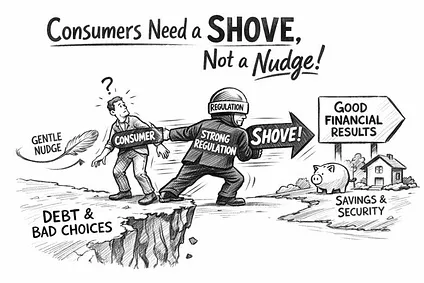
Americans have never had more financial products from which to choose – and have never been more confused about what to do with them. Retirement accounts, mortgages, insurance policies and investment vehicles promise security but often deliver disappointment. In a new book, economists John Campbell and Tarun Ramadorai argue that this is no accident.
The system, they say, is designed in ways that exploit our worst financial instincts rather than correct them.
Campbell, a professor of economics at Harvard, and Ramadorai, who teaches at the Imperial College London, document these problems and solutions in their just-published book, Fixed: Why Personal Finance is Broken and How to Make It Work for Everyone.
The authors offer familiar examples of those whose life savings have been ruined by misfortune and mistakes: a former Enron employee whose 401(k) vanished when the company went bankrupt, a recent graduate who is suffocating from student debt, and someone whose assets were plundered when sold unnecessarily complex investment products.
Those poignant examples deserve a solution, and the authors offer good steps toward one.
The scope of the problem
Let’s begin with the underlying causes of so much financial distress.
Making sound financial decisions is complicated by predictable forms of irrational behavior. According to the authors, we rely too heavily on the advice and examples of our friends, have trouble comprehending the power of compound growth, and inaccurately measure the riskiness of choices and our tolerance of that risk. Those biases frame the authors’ position that most people are compromised in their financial decision-making abilities.
The financial services industry takes advantage of our biases by creating products that, as the authors write, “exacerbate and exploit mistakes rather than correct for them, with questionable benefits, high costs, and unnecessary complexity.” Products like annuities are offered without the framework to properly evaluate their benefits. Product costs are hard to perceive because they are expressed as percentages rather than dollar amounts. Vendors make it difficult to shop for products; the authors cite a study that the average home buyer pays $1,000 more than necessary for a mortgage because they fail to shop for the best deal. Consumers don’t properly manage the products they own, such as failing to refinance when rates decline.
Financial service providers operate without the appropriate regulations or incentives to properly serve consumers. For example, there isn’t enough to protect consumers in complex markets like mortgages, student loans, retirement saving, and insurance. The authors argue that regulators have not required simplicity or transparency that would counteract systematic disadvantages faced by typical consumers.
Where does wealth inequality fit in?
These failures do not fall evenly across society. Campbell and Ramadorai extend their critique beyond individual mistakes to a broader claim: that the personal finance system itself is a driver of wealth inequality. If true, the implications would be sweeping – not merely for consumer protection, but for economic policy more broadly.
They call wealth inequality one of the “the defining concerns of the early 20 th century.” They place blame on the financial system because the wealthy have better performing investments, borrow more cheaply and save more.
Let’s look at those claims.
The question of wealth inequality is more complex than the book allows. Wealth inequality in the U.S. has undeniably risen in the U.S. over the last 50 years, as more wealth has been consolidated in the hands of the top 1% and top 0.1% of Americans. But the gap in income inequality is less pronounced, as the authors acknowledge, especially once the effect of taxation and transfer payments (e.g., welfare and other government subsidies) are considered. Moreover, the poverty rate in the U.S. has declined from about 22% to 10% since 1960, once one includes government programs such as food stamps, rent subsidies and tax credits.
There is mixed evidence that the investments available to the wealthy (accredited investors), such as private equity, venture capital and hedge funds, perform any better on average than a low-cost, diversified index fund. This is true on a nominal basis, and it is truer once one adjusts for risk and liquidity. The wealthy may be able to borrow at lower rates than someone with inferior credit, but that does not argue for making cheap debt widely available. Debt, at least for the less wealthy, should be discouraged in all cases, apart from a home mortgage. The wealthy save more, on a percentage and absolute basis, because their earnings exceeded their cost of living.
The drivers of wealth inequality were examined by Thomas Pitetty in his 2013 book, Capital in the Twenty-First Century. The cause, according to Piketty, was that the returns to capital exceeded the returns to labor. Investment returns rose faster than wage growth. That was driven by several factors, such as the decreased power of labor (e.g., through unions) and tax policies favorable to corporations.
Moreover, wealth inequality has been at least partially driven by the period of low interest rates that have characterized much of the last 20 years. That has penalized the less affluent who earn meager returns on their savings and has encouraged them to speculate in risky investments. It has rewarded the wealthy, building the fortunes of the general partners of the PE, VC and hedge funds who have extracted high fees from their investors.
Poverty remains a problem in the U.S., and it should be the role of the government to care for the neediest. But solutions to address this by reducing wealth inequality are structurally incompatible with market-based systems. Supposed solutions that aim to address claims that the wealthy have access to better investments or cheaper debt are misdirected.
Whether one accepts that diagnosis or not, the inequality debate underscores a broader point on which the authors are on firmer ground. Even in a wealthy society, financial complexity, opacity and conflicted incentives impose disproportionate costs on those least equipped to bear them. That is the problem their proposed reforms will address.
Solutions
The author’s solution to address the shortcomings of personal finance begins with the thesis that we need a “shove” rather than a “nudge.” The power of nudging was popularized by Richard Thaler and Cass Sunstein, for which the former won the 2017 Nobel Prize in economics. It posits that we can be led to make economically superior decisions by making subtle changes in the way choices are presented. For example, 401(k) contributions can be increased by making plan participation the default option when employees enroll.
But those nudges are insufficient to solve the financial problems the authors document. Indeed, they cite a study showing that nudges have only a quarter of the effect that has been reported in academic research, because that research focuses only on the examples that have outsized benefits. The authors conclude that “the promise of libertarian paternalism, that households can be helped without restricting their choices or changing the prices they face, is too good to be true.”
The “shove” that the authors advocate begins by offering a mandatory “starter kit” to consumers. This is a package of financial products that are simple, safe, cheap and easy to use. Any financial service provider would need to offer an element of the starter kit along with their own offerings. For example, life insurance companies would need to offer a basic term policy in addition to whatever whole life or other products they sell.
This would be supported by regulatory changes. Bureaucracy would be streamlined, and consumer oversight be consolidated and overseen by the Consumer Financial Protection Bureau (CFPB). (The book was published before the Trump administration’s cuts to the CFPB.) Products would be simplified; banks would be required to offer adjustable-rate mortgages without introductory “teaser” rates and fixed-rate mortgages without points, to facilitate the decision as to whether to refinance. Providers would be required to state their fees in consistent, easy-to-understand units.
The authors make no recommendations for changing the fiduciary standard. They concede that RIAs should be held to that standard but agree with fiduciary opponents that broadening that standard would limit the ability of service providers to advise less-wealthy clients. They state that the growth of robo-advisers is sufficient to serve the needs of the less wealthy, obviating the need to impose a stricter standard on brokers.
But even if robo-advice were a valid alternative – which is a problematic assumption – that should not excuse brokers and other non-fiduciaries from avoiding the requirement to act in the consumer’s best interests. It is unacceptable for someone to be sold an investment, insurance or other financial product unless all conflicts of interest have been disclosed and minimized and the product is genuinely in the consumer’s best interest.
A 2017 study by the Department of Labor (DOL) showed that there were $17 billion in losses suffered annually by investors who relied on non-fiduciary advice, and that reflects only money in retirement accounts. The magnitude of those losses, which reflect underperformance due to high fees and improper products, was confirmed in another study by the DOL. A study published last year by the CFP Board showed that 39% of Americans lost at least $250 and 18% lost over $1,000 annually due to poor financial guidance, although those figures were not limited to non-fiduciary advisors.
Those are conservative estimates, since many people will not report their losses for fear of embarrassment – or because they lack the education to recognize the bad advice they have been given.
Even where Campbell and Ramadorai overreach, their central insight should not be dismissed. Personal finance failures are not merely the product of individual errors but of systems that tolerate confusion, opacity and conflicted advice. Nudges may help at the margins. Preventing financial ruin, however, will require firmer rules – and a greater willingness to admit that markets do not always protect the people they are meant to serve.
Robert Huebscher was the founder of Advisor Perspectives and its CEO until the company was acquired by VettaFi in 2022. He was a vice chairman of VettaFi/TMX until April 2024.